One System, One Standard: The Strategic Case for Unified Trade Compliance Across Global Markets

Photo: National Photo Company Collection, restored by Adam Cuerden, Public domain, via Wikimedia Commons
For many US companies operating internationally, trade compliance is managed the way a traveler might handle foreign currency—one country at a time, often improvised, and almost never with a coherent strategy tying everything together. The result is a patchwork of regional compliance teams, duplicated data repositories, and regulatory workflows that rarely speak to one another. The inefficiencies are real. The costs, however, are frequently invisible until something goes wrong.
This is the compliance fragmentation problem, and it is quietly undermining the international competitiveness of American businesses at a moment when global trade demands precisely the opposite.
The Architecture of a Broken System
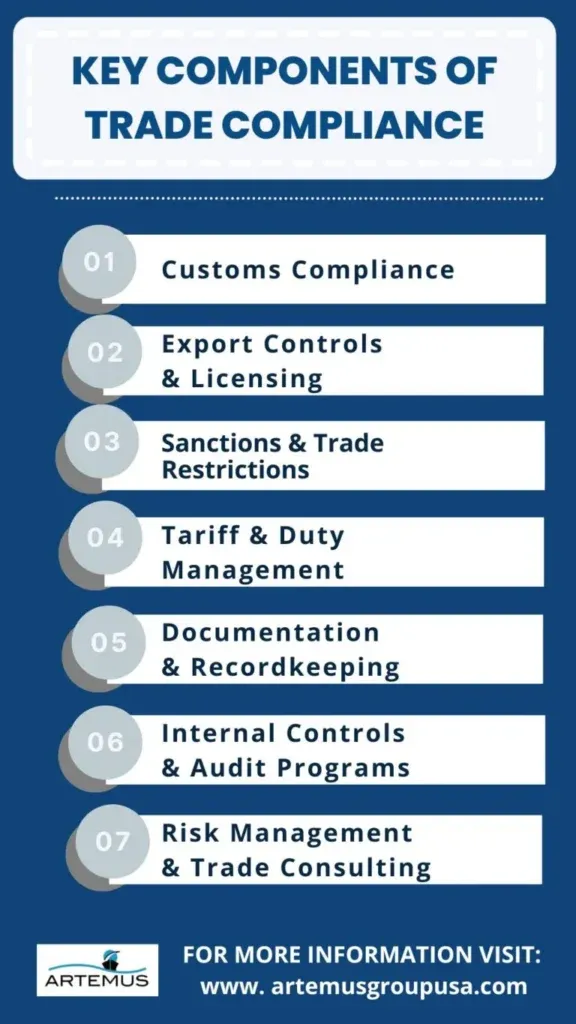
When a mid-sized US manufacturer enters its third or fourth international market, something predictable happens. Compliance functions that were once manageable—export licensing, tariff classification, sanctions screening, country-of-origin documentation—begin to multiply. Each new jurisdiction introduces its own regulatory logic, its own documentation requirements, and its own enforcement priorities.
Rather than building a unified system capable of accommodating this complexity, most companies default to the path of least resistance: they hire local compliance staff, engage regional legal counsel, and construct separate workflows for each market. On the surface, this appears pragmatic. In practice, it creates a fragmented architecture where the left hand rarely knows what the right hand is doing.
The consequences accumulate gradually. A tariff classification applied one way in Germany is handled differently for the same product line entering South Korea. An export control determination made by the US team is not automatically reflected in the documentation generated by the regional office. Sanctions list updates are applied inconsistently across markets. None of these discrepancies necessarily trigger an immediate crisis—but each one represents latent legal exposure and operational drag that compounds over time.
The True Cost of Siloed Compliance
Compliance fragmentation carries a financial burden that rarely appears on any single line item in a company's budget, which is precisely why it persists. The costs are distributed across departments, buried in legal fees, absorbed into operational overhead, and occasionally realized in the form of regulatory penalties that seem to arrive without warning.
Consider the labor redundancy alone. When separate regional teams are each maintaining their own compliance databases, conducting their own regulatory monitoring, and producing their own documentation workflows, the organization is paying multiple times for the same function. A unified system, by contrast, allows a centralized team to produce regulatory intelligence that cascades across all markets simultaneously, eliminating duplication at the source.
Beyond labor costs, fragmented compliance architectures create meaningful error risk. When regulatory data exists in multiple siloed systems that are not synchronized, version control becomes a persistent challenge. A sanctions list update or a change in export classification that is captured in one regional system but not another is not merely an administrative inconvenience—it is a potential violation with real legal consequences under US export control law, including the Export Administration Regulations and the International Traffic in Arms Regulations.
Perhaps most consequentially, fragmented compliance slows market entry. When every new jurisdiction requires building a separate compliance infrastructure from scratch, the time and capital investment required to enter a new market increases substantially. For companies competing against rivals who have already solved this problem, that delay is a competitive disadvantage measured in months, not days.
Rethinking Compliance as a Strategic Function
The companies that are pulling ahead in global trade are not simply managing compliance more carefully—they are fundamentally rethinking what compliance is for. Rather than treating it as a regional cost center designed to keep the company out of trouble, they are positioning it as an integrated strategic function that enables faster, more confident international growth.
This reorientation begins with a commitment to a single source of truth: one centralized platform or framework that consolidates regulatory intelligence across all markets, product lines, and transaction types. This does not mean ignoring local nuance—every jurisdiction will always have its own specific requirements. What it means is that the organizational logic for managing those requirements is unified, so that updates, determinations, and documentation standards flow from one coherent system rather than from a collection of disconnected regional silos.
Leading organizations are investing in trade compliance technology platforms that integrate with their enterprise resource planning systems, allowing regulatory data to inform procurement decisions, pricing models, and logistics planning in real time. When a change in tariff classification affects landed costs in a particular market, that information surfaces immediately across the relevant business functions rather than remaining confined to a compliance team operating in isolation.
The Market Entry Dividend
One of the most underappreciated benefits of unified compliance is its effect on speed to market. When the regulatory framework for a new geography can be incorporated into an existing compliance architecture rather than built from the ground up, the time required to qualify a new market drops significantly. Legal review becomes more efficient because counsel is working within a familiar framework. Documentation workflows can be adapted from existing templates rather than created wholesale. Risk assessments are more accurate because they draw on a broader base of institutional knowledge.
For US companies targeting expansion into high-growth markets across Asia, the Middle East, or Latin America, this acceleration is not a minor operational benefit—it is a material competitive advantage. Being first or second into a market with a compliant, well-structured commercial offering can define long-term positioning in ways that are difficult to reverse.
Building Toward Integration
The transition from fragmented compliance to a unified model is not without its challenges. Companies with established regional operations will encounter institutional resistance, data migration complexity, and the genuine difficulty of harmonizing processes that have evolved independently over years. These obstacles are real, but they are manageable with deliberate planning and executive commitment.
The starting point is typically a compliance audit that maps the current state: how many systems exist, where data is being duplicated, where regulatory determinations are being made inconsistently, and where the organization's legal exposure is most concentrated. That audit provides the foundation for a rationalization plan that consolidates systems, standardizes processes, and establishes clear governance for maintaining a single source of regulatory truth.
For US companies serious about building durable international operations, the investment is not optional. As global trade becomes more regulated, more scrutinized, and more consequential, the organizations that thrive will be those that have turned compliance into a capability rather than a liability—one coherent system serving every market they touch.