Holding the Line on Margins: How American Exporters Can Manage Currency Risk Without Sacrificing Global Reach
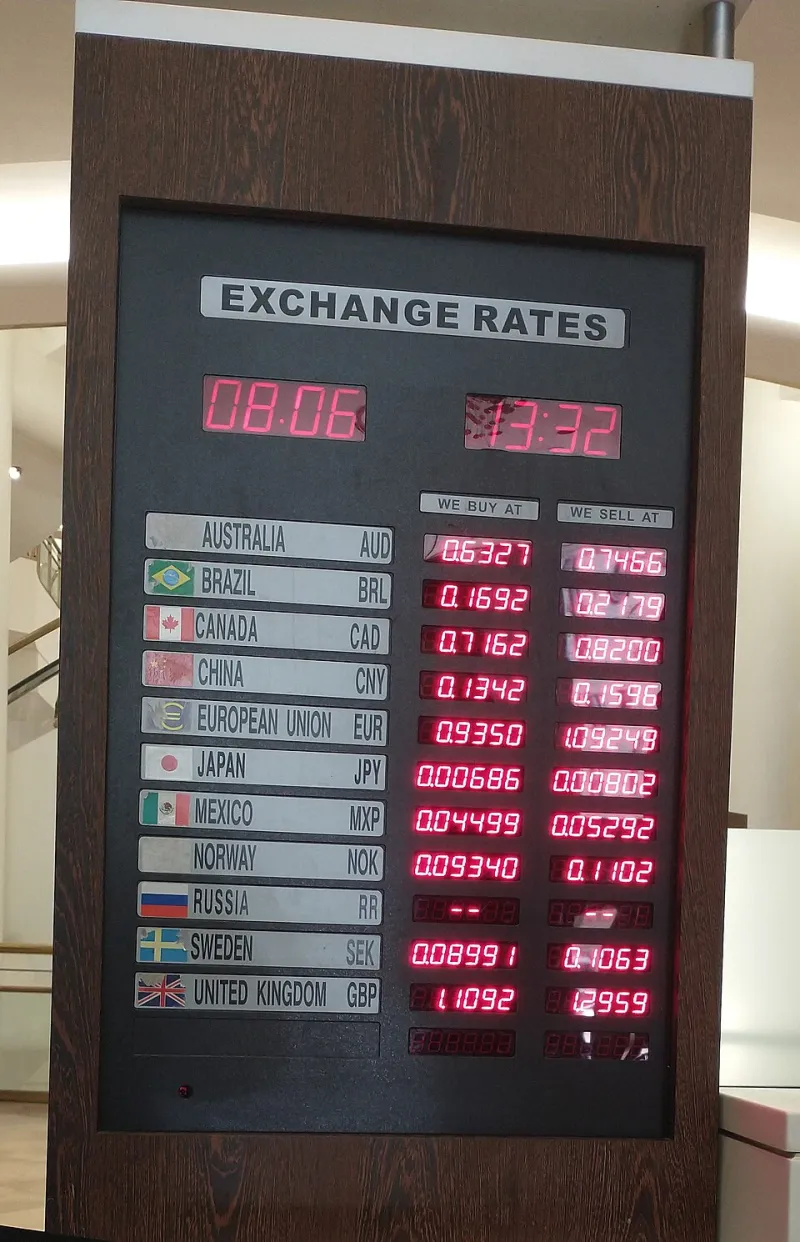
Photo: Dvortygirl, CC BY-SA 4.0, via Wikimedia Commons
The Currency Problem No One Plans For—Until It's Too Late
American companies entering international markets typically spend considerable time analyzing demand, competition, and logistics. Currency risk, by contrast, often receives only passing attention in the initial planning phase—until a sharp devaluation or an unexpected inflation spike in a key market turns a profitable contract into a loss-generating liability.
This pattern is surprisingly consistent across industries and company sizes. A US technology exporter might price a multi-year services agreement in local currency to win a contract, only to watch a 20 percent depreciation in that currency translate directly into a 20 percent reduction in dollar-denominated revenue. A manufacturer selling capital equipment to buyers in emerging markets may find that customers are suddenly unable to service dollar-denominated debt after a currency shock, leading to delayed payments or contract renegotiations.
The challenge is not unique to small or inexperienced exporters. Even sophisticated multinationals have absorbed material earnings hits from currency movements they failed to adequately hedge. What separates companies that manage this risk effectively from those that do not is less about financial sophistication and more about discipline—the discipline to build currency risk management into commercial strategy from the outset.
Understanding the Exposure Before Choosing the Tool
Effective currency risk management begins with a clear-eyed assessment of where the exposure actually sits. US exporters typically face three distinct categories of foreign exchange risk.
Transaction exposure arises from specific, identifiable cash flows denominated in foreign currencies—an invoice issued in euros, a contract priced in Mexican pesos, a receivable due in South African rand. This is the most visible form of currency risk and the one most amenable to direct hedging.
Translation exposure affects companies that consolidate financial statements across multiple currencies. When a US parent company reports the earnings of a foreign subsidiary, fluctuations in the exchange rate between the subsidiary's functional currency and the US dollar directly affect reported income, even if no actual cash has changed hands.
Economic exposure is the broadest and most difficult to manage. It refers to the impact of currency movements on a company's competitive position—for instance, a strengthening US dollar that makes American-made goods more expensive relative to locally produced alternatives, regardless of how individual contracts are structured.
A company that conflates these three categories—or addresses only the most visible one—will find that its hedging program delivers incomplete protection.
Hedging Instruments: Matching the Tool to the Exposure
For transaction-level risk, US exporters have access to a range of financial instruments, each with distinct cost and flexibility profiles.
Forward contracts allow a company to lock in a specific exchange rate for a future transaction. They are straightforward, widely available through commercial banks, and appropriate for exporters with predictable, contract-based cash flows. The limitation is inflexibility: if the underlying transaction is delayed or cancelled, the company remains obligated under the forward contract.
Currency options provide the right, but not the obligation, to exchange currency at a predetermined rate. They offer greater flexibility than forwards but carry an upfront premium cost. Options are particularly useful when the timing or volume of a foreign currency receipt is uncertain—a common scenario for exporters selling through distributors or operating in markets where payment timelines are less predictable.
Natural hedging involves structuring operations so that foreign currency revenues and costs offset each other. A US company that sources inputs from the same market in which it sells can reduce its net currency exposure without using financial instruments at all. This approach requires operational flexibility but carries no premium cost and can be highly effective for companies with significant in-country footprints.
Currency swaps are more complex instruments generally suited to larger exposures or longer-duration financing arrangements. They are less commonly used by mid-market exporters but merit consideration for companies with substantial cross-border capital flows.
Pricing Architecture: Building Currency Resilience Into Commercial Contracts
Financial hedging is only one dimension of currency risk management. The structure of commercial contracts can be equally important in protecting margins over time.
US exporters operating in volatile currency environments should consider incorporating currency adjustment clauses into long-term agreements. These provisions allow prices to be revised if the exchange rate between the contract currency and the US dollar moves beyond a defined threshold. While some buyers will resist such clauses, they are increasingly standard practice in markets with histories of significant currency instability.
Invoicing in US dollars is the simplest approach to transaction exposure—it transfers the currency risk to the buyer rather than the seller. This strategy is most viable when the exporter has significant pricing power or when the product is priced in dollars as an industry convention, as is common in commodities and certain technology categories. In highly competitive markets, dollar invoicing may not be commercially feasible, but it should always be the starting point for negotiation.
Shorter payment terms reduce the window during which exchange rate movements can erode the value of a receivable. Exporters who can negotiate 30-day terms rather than 90-day terms in volatile markets are effectively reducing their currency exposure without using any financial instrument.
Inflation Pressures: A Distinct but Related Challenge
In many of the emerging markets that offer the greatest growth potential for US exporters—parts of Latin America, Sub-Saharan Africa, and South Asia—currency depreciation is closely correlated with domestic inflation. This creates a compound problem: the local currency value of a contract may remain stable while its purchasing power, and the buyer's ability to perform, erodes in real terms.
Exporters should monitor inflation indicators in key markets with the same rigor they apply to exchange rate movements. In high-inflation environments, pricing models that rely on fixed costs over multi-year periods are particularly vulnerable. Indexing contract values to inflation benchmarks—or to the price of key inputs—can provide a degree of protection that pure currency hedging does not.
The Strategic Imperative: Risk Management as a Growth Enabler
It is worth reframing the purpose of currency risk management. The objective is not to avoid international markets because they carry financial complexity. It is to build the financial infrastructure that allows a US company to compete confidently in those markets—to price aggressively, commit to long-term relationships, and invest in market development without exposing the business to existential currency shocks.
At Noor Safi Group, we work with US companies at precisely this intersection of commercial ambition and financial discipline. Our cross-border experience informs not only how we structure international transactions, but how we advise partners on the financial architecture that makes global growth sustainable. Currency volatility is a permanent feature of international commerce. With the right strategies in place, it need not be a barrier to building value across borders.